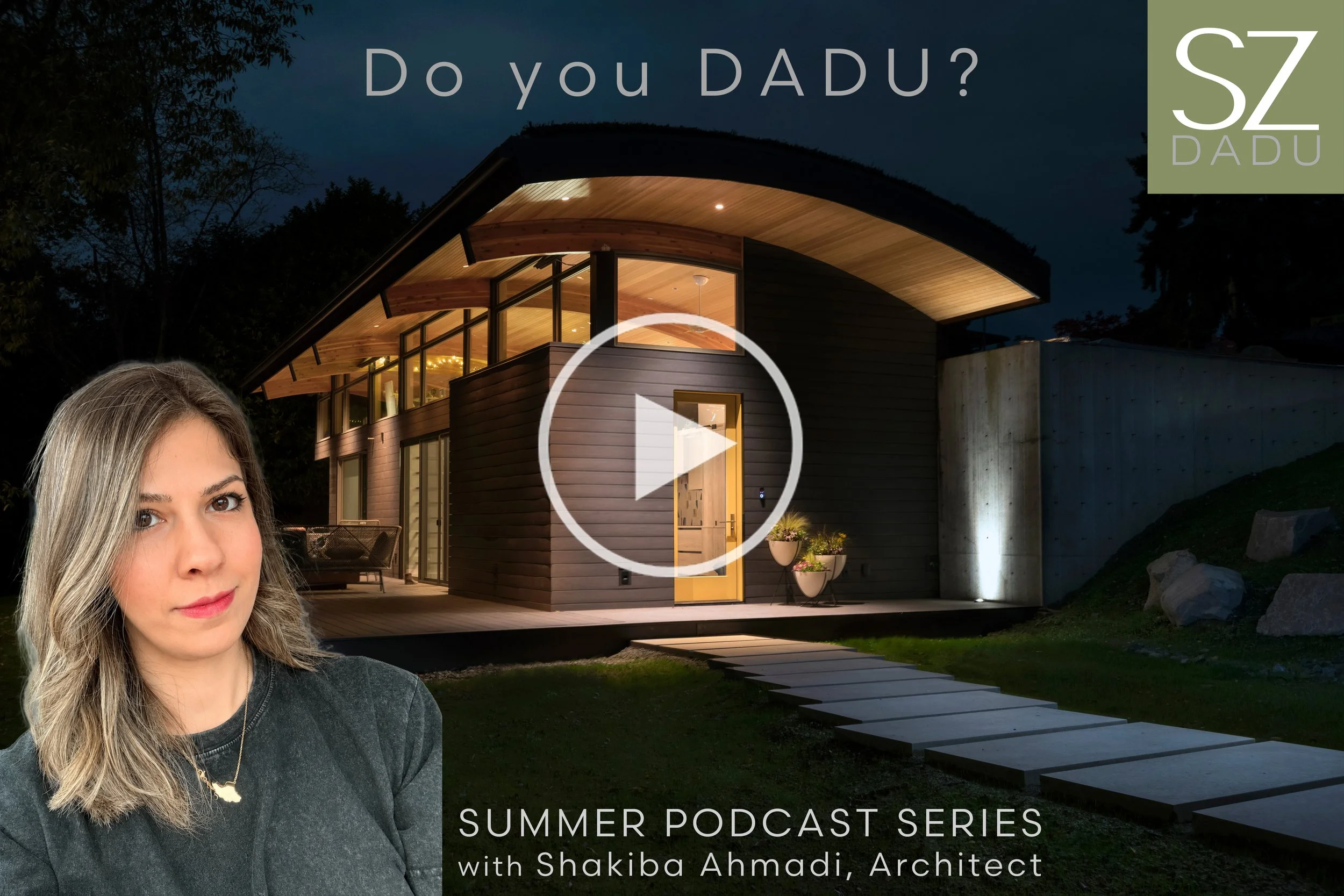
Enjoy a sneak peek into an Architect’s new home on Mercer Island. Perched uphill from her recently built 750 SF Guest House, Suzanne Zahr’s beautiful 3,300 SF family home is organized around a featured ‘spine wall’ running North-South, paying homage to an indigenous rammed earth building methodology. A split ridge roof with clerestory windows is seated above, allowing for natural light to travel through the main living areas from dawn to dusk. Thoughtful site orientation and efficient space planning enable passive solar design to maximize heat retention and minimize energy use, which ultimately offers a general sense of ambient well-being. Taking advantage of the sloped site, the stormwater gravity flows into an on-site detention tank, minimizing the impact to municipal stormwater drainage system that flows into Lake Washington.
Read MoreRealtors Private Tour: Architect's Home on Mercer Island
Storybook Pond Residence.
Surrounded by towering maple and pine trees, a babbling brook leading to a frog pond, the scene is set for an Artist’s studio and family home. The extensive transformation in Duvall, WA is rooted in connecting an open layout to its natural environment.
Large gable-end windows compliment a continuous 30’ ridge skylight, flooding the main living space with warm diffused light. An expansive kitchen opens to the dining area and is booked-ended by a living room with a stone wrapped fireplace. This great room connects to a large outdoor deck, bridging the garden views.
This home is designed to the specific programming needs of our client, allowing for a tranquil primary suite with a floating tub and custom sauna. Other amenities include a dog-washing mud room, hydraulic elevator, art studio space with a private deck overlooking the landscape, providing ample inspiration.
From elegant detailing to larger architectural concepts creating clear axes and open flow, this design offers a nod to the previous farmhouse home, while introducing a modern experience. A carefully curated material palette brings natural elements inside and out, with stone wrapped walls, natural finishes, warm textures and accents of wood throughout, blending into its surrounding landscape.
Read MorePERSIAN GARDEN by Monir & Mehdi Ghanbeigy.
SZ Gallery’s 5th Persian Garden, opening [First] Friday, December 5, 2025, is an exhibit that tells culturally rich stories of Persian culture through contemporary and classically-influenced pieces. Monir & Mehdi Ghanbeigy from Iran have created multimedia artwork together since 1970, combining Mehdi’s detailed work with Persian miniatures and painting, Monir’s background in ceramics, and their mutual love for the history of Persian art.
Monir and Mehdi began working together in Iran before they moved to England for further training at London and Canterbury College of Art. After returning to Iran in 1980, they developed a novel style in ceramics and painting, influenced by both modern art as well as the very rich traditions of Persian pottery and storybook miniatures. They have shown their art at numerous national and international exhibitions, including the 2012 Venice Biennial, and have taught for many years at several universities in Iran and in their private workshop. Their pieces are permanently on exhibit at the Contemporary Art Museum in Iran, as well as several museums around the world.
Read MoreHOUSELESSNESS by Mohammed Joha.
16 November 2025 - 11 January 2026
Zawyeh Gallery, Dubai
Unit 27, Alserkal Avenue
In his latest exhibition Houselessness, Palestinian artist Mohammed Joha redefines collage not merely as a visual technique, but as an architecture of rupture and reassembly, both a method and a metaphor. His works bring together scraps of fabric, paper, cardboard, plastic and other salvaged materials, textures pulled from shattered environments and fragments of personal history, to form compressed, jostling topographies. They convey not only violence and destruction, but also endurance and resistance: a continuation of life within erasure.
Born in Gaza, Joha has lived in Europe for over two decades. Yet Gaza remains intimately present in his life and work: his family and friends are still there, many of whom were recently martyred. His home, along with more than 500 paintings, lies buried beneath the rubble. The act of stitching together recycled materials, including torn pieces of his own clothing, reflects an iterative process of healing and comprehension: one that is both personal and collective, and continuously undermined by decades of violence and ongoing genocide.
For Joha, this is where the distinction between Houselessness and homelessness is vital. ‘We are without houses, not without a home. Our homeland is Palestine,’ he says. The loss his works express is not only architectural but existential: a condition of enforced displacement, where lives are rebuilt on ever more precarious ground, with ever fewer materials.
Visible seams and tears convey this sense of fragility and urgency, while tumultuous grey colour fields in works such as Houseless 05 and 06 evoke polluted skies, impenetrable clouds of dust and the psychic weight of living beneath occupation. Yet even these are not without hope. Between the grey and amid the cramped, collaged settlements are glimpses of vivid colour, cobalt blue, canary yellow, pink, purple, green, alongside fragments of pattern, lace, tartan, decorative swirls. These details are memory ruptures: remnants of life, of domestic intimacy, of a world before its most recent devastation. They speak to Joha’s insistence that, even amid destruction, life persists.
While rooted in the specificity of Gaza, Joha’s work carries global resonance. His use of collage echoes diasporic traditions of survival and adaptation, yet with an unmistakably contemporary urgency. In this way, his canvases become not only representations of collapse, but sites of reconstruction: an architecture of dignity, resistance and care.
Read More